E-Coating for Truck Cargo Bodies: Why It Matters
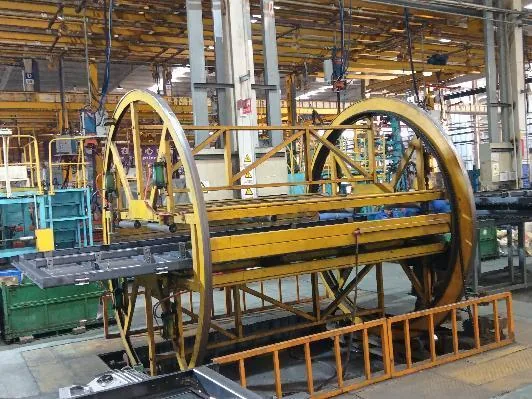
A steel cargo body usually does not fail in the middle of a flat panel. It fails at a welded seam, a folded edge, a rivet line or inside a closed box section, where water and road salt sit and ordinary paint cannot reach. That is why the coating process matters as much as the steel thickness. E-coating, or electrophoretic deposition, is designed to put a protective primer into exactly those places.
Hailong builds steel cargo bodies with full e-coating followed by high-temperature baking paint. This article explains what the process does, how to design a body for it, and what to specify when comparing truck body suppliers.
What e-coating is
In an e-coat line, the cleaned steel body is immersed in a paint bath. An electrical current causes charged paint particles to deposit on the conductive steel surface. The body is then rinsed and baked, leaving a cured primer film. Because the part is fully immersed and the paint is driven by current, the coating reaches internal surfaces, seams and edges that a spray gun cannot see.
The result is a uniform primer over the whole steel structure, not just the visible panels. E-coat is usually a primer; the finish coat provides color and weather resistance.
The process sequence
- Cleaning and pretreatment. Oil, scale and welding residue are removed, and the steel is prepared so the coating can bond.
- E-coat bath. The body is immersed and electrically coated, including internal cavities and the back of overlaps.
- Rinse. Excess bath material is removed before curing.
- Bake. The primer is cured at the specified temperature.
- Topcoat. The finish paint is applied over the cured primer for color and weather resistance.
Each step matters. A clean, properly pretreated surface gives adhesion; the bath and electrical parameters control film build; the bake controls cure. A supplier that skips pretreatment or undercures the primer may produce a body that looks correct on delivery but fails at the first seam.
Why it matters on a cargo body
Cargo bodies see water, mud, fertilizer, salt, livestock waste and repeated washing. Water collects at the bottom of side panels, around the floor-to-side joint, inside the rear frame and behind reinforcing ribs. Once corrosion starts in a seam, it works outward under the paint and is difficult to stop.
E-coating is most valuable where the body is difficult to inspect: closed profiles, overlapping sheets, the inside of the front panel, the underside of the floor and the area around the wheel boxes. It also protects cut edges and welded zones, which are common starting points for rust.
Design details that make e-coating work
- Drain and vent holes. Every closed section needs a low-point drain and a high-point vent so the bath can enter, drain and rinse.
- No sealed cavities. A fully sealed box traps air and prevents the coating from reaching the interior.
- Hanging and grounding points. The body needs stable contact points for the electrical circuit and safe lifting through the line.
- Masking. Threads, machined surfaces and areas that will be welded later may need masking before coating.
- Seam access. Overlaps should allow pretreatment chemicals and rinse water to drain; otherwise they can bleed out during baking.
Review these details at the drawing stage; a drain added after fabrication may not reach the lowest point.
What to specify
When comparing suppliers, ask for more than the word “e-coated.” Specify full immersion of the steel structure, the pretreatment sequence, the bake and cure requirements, and the topcoat system. Confirm that internal cavities, seams and cut edges are included, not just the outer skin.
Ask how the supplier controls bath chemistry, film build and cure, and what records are kept per batch. In coastal or winter-salt service, discuss the expected conditions and maintenance plan. Do not rely on thickness alone; adhesion, coverage and cure matter as much.
Maintenance after delivery
E-coating extends body life but does not eliminate maintenance. Wash off salt and abrasives, keep drain holes clear, and repair chips before bare steel is exposed. For touch-up, clean the area, remove loose coating and use compatible primer and topcoat.
Hailong’s cargo body finish
Hailong’s steel cargo bodies are fully e-coated and finished with high-temperature baking paint. Production is based at the group’s Bei’an Intelligent Manufacturing Park, with capacity for about 30,000 cargo body sets a year. The group was founded in 1955 and is certified to IATF 16949, ISO 9001, ISO 14001 and ISO 45001.
If you are specifying a fleet of steel cargo bodies, include the finish requirements in the same document as the dimensions, payload and chassis interface. That keeps the coating, drainage and structural details coordinated from the first drawing.
Send us your cargo body finish requirements
Tell us the chassis model, material carried, payload, dimensions, quantity and destination market. Email nora@qdhailong.com or call +86-532-66090318, or use the quotation form.